
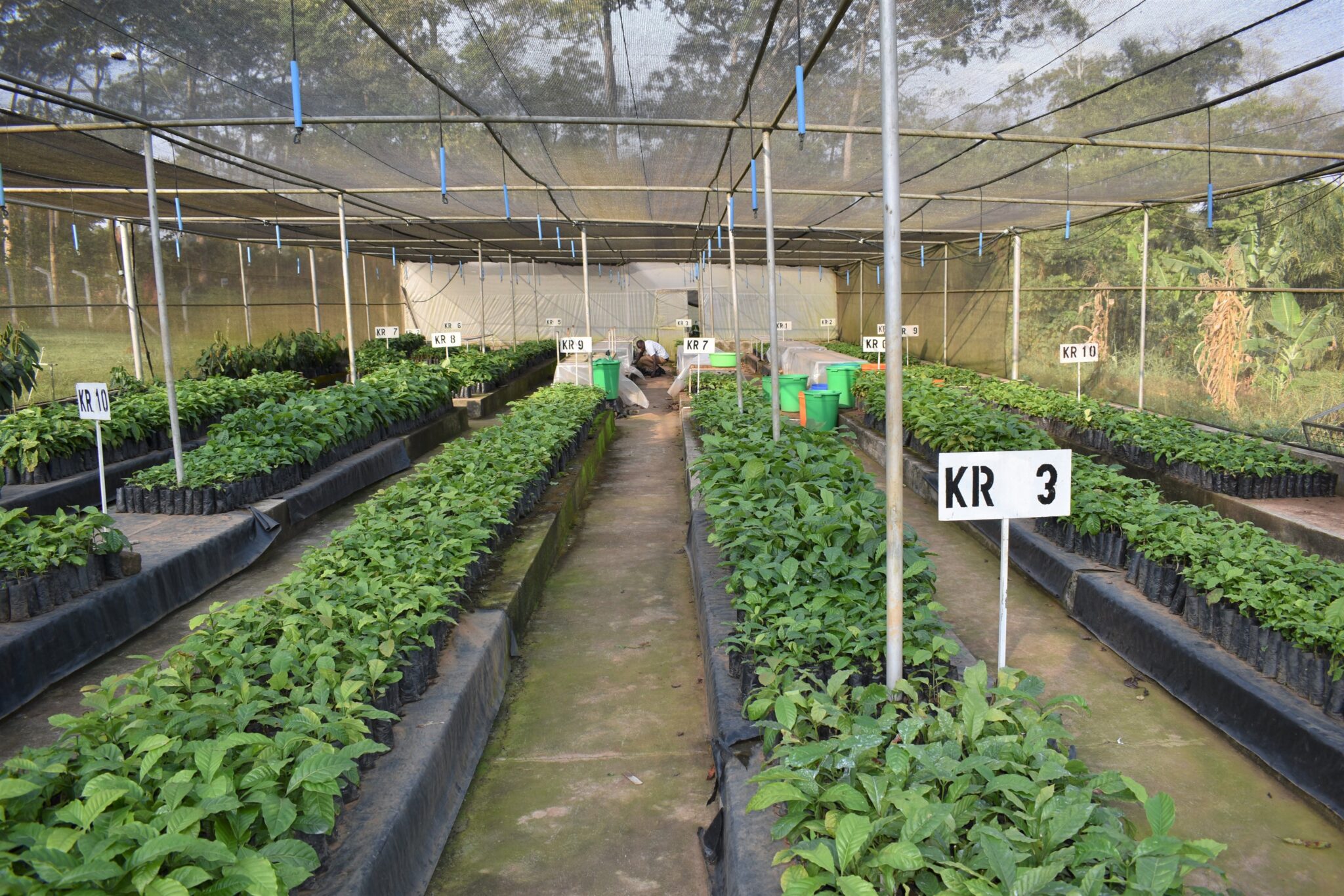

For generations, Uganda’s rolling coffee fields have powered rural economies, shaped cultural identity and supplied global markets with some of the world’s finest Robusta. But as temperatures rise and rainfall becomes unpredictable, the country’s most important agricultural export faces one of its greatest threats.
In response, a quiet scientific revolution is unfolding at the National Coffee Research Institute (NaCORI) in Kituza, where Ugandan and international researchers are developing a new line of drought-tolerant, high-yielding Robusta varieties that could secure the future of the crop, and the livelihoods of the 1.8 million households that depend on it.
Backed by the European Union through the French research organisation CIRAD, these efforts represent one of the most ambitious attempts yet to climate-proof a crop central to Uganda’s economy, which earned US$2.2 billion from coffee exports in the 2024/25 financial year.
But beyond statistics, the work in the greenhouses and field plots of NaCORI tells a deeper story, a nation adapting to survive, scientists pushing the boundaries of plant genetics, and farmers waiting anxiously for solutions.
The search for resilience
Uganda’s Robusta coffee is naturally diverse, but climate pressure is exposing its weaknesses. Droughts are longer, temperatures hotter, and many once-reliable varieties now struggle to withstand extreme weather.
“Our job as breeders is to predict the future and prepare farmers for it,” explains Dr. Pascal Musoli, senior coffee breeder at NaCORI. “The climate is changing faster than expected. That means our varieties must change too. We are not just breeding plants, we are building resilience for millions of families.”
The drought-tolerant breeding programme began in 2022 after the EU and CIRAD committed €713,000 to support a three-year project aimed at identifying, testing and eventually releasing coffee varieties that can survive prolonged dry spells while maintaining high yields and good cup quality.
Genetic diversity and germplasm screening
The heart of NaCORI’s research lies in its vast coffee gene bank, one of the richest collections of Robusta diversity in the region. Inside, hundreds of accessions gathered over decades represent the foundation for the next generation of climate-smart varieties.
To accelerate the search for resilience, researchers first screened this genetic material under controlled drought conditions.
“We created an artificial drought in the Screen House to force the plants to reveal their natural strengths, we wanted to see which plants could endure stress without shutting down”, Ali Milton, a Makerere University PhD student attached to NaCORI, explained.
Milton subjected promising varieties to three weeks without water, closely observing physiological and physical responses. Some wilted within five days. Others survived a week. But a small group stunned the researchers, remaining green and stable for the entire 21-day period.
“Those plants taught us something important, the genes for drought tolerance already exist within Uganda’s Robusta population. Our work is to find them, measure them, and multiply them”, Milton says. From hundreds of accessions, Milton identified 17 highly tolerant candidates.
Taking science to the farmers’ fields
Drought-tolerant behaviour in controlled environments is encouraging, but field conditions are far harsher. To confirm their potential, NaCORI researchers established trials in drought-prone districts including Nakaseke, Sembabule and Ntungamo.
Here, temperatures soar, rainfall is increasingly erratic, and farmers have endured years of declining yields.
“The real test is not the greenhouse; it is the village field during a bad season, if a plant can survive there, it can survive anywhere”, says Dr. Musoli.
So far, the results are promising. Four of the 17 varieties continue to demonstrate strong tolerance in field conditions, with some outperforming the country’s current top-performing KR8, KR9 and KR10 varieties in early yield assessments.
“These new materials are showing big, well-filled cherries and impressive drought stability, they are still young, but their performance suggests they may give farmers new hope in the coming years”, says Musoli.
A race against deforestation
While greenhouse and field trials continue, another critical part of the project is unfolding deep inside Uganda’s forests. Mildred Nakanwagi, a Makerere PhD student working under NaCORI and CIRAD, is leading expeditions to document and collect wild Robusta from threatened natural habitats.
“Forests hold our original Robusta, the pure genetic material from which all domesticated types came,” she says. “But these forests are disappearing fast, and with them, unique coffee traits we may never recover.”
Since 2022, her team has visited ten forests including Zoka, Semuliki, Mabira, Budongo, Itwara and Maramagambo, gathering rare germplasm that may carry hidden resilience traits.
The discoveries are striking
“In Zoka, in Northern Uganda, we found Robusta growing naturally in extremely harsh, dry conditions, these plants have adapted over generations. That makes them priceless for breeding”, Nakanwagi explains
However, she warns that deforestation, driven by charcoal burning, illegal settlements and land clearing, is rapidly erasing this natural heritage.
“People are cutting down wild coffee trees because they believe the wood burns better, if this continues, Uganda could lose genetic material that is irreplaceable. Protecting these forests is protecting the future of our coffee sector”, she says
The long road to a new variety
Even with promising results, releasing a new coffee variety in Uganda can take between five and six years. Researchers must collect continuous data, observe plant behaviour across seasons, test for pests, diseases, yield and cup quality, and ensure consistency.
“The science is slow because it must be accurate, farmers only plant what they trust. So, we must present strong evidence”, says Dr. Musoli
Limited funding, however, threatens to delay progress. The current EU-supported project ends this year, yet researchers still need at least three more years to collect the full data set required for approval.
“As scientists, we would love to monitor these plants every week, but without consistent funding, we sometimes miss field visits. Every gap in data pushes the release date further away”, Musoli says
He estimates that instead of three years, it may take six years to gather enough evidence for variety approval unless additional support is secured.
A global effort with local impact
CIRAD experts working alongside NaCORI say Uganda’s work is of international significance.
“Robusta is the backbone of global instant coffee and an essential component of many blends, with rising temperatures worldwide, the world needs climate-resilient Robusta. Uganda is leading that effort”, Dr. Mathieu Gonin from CIRAD.
The EU’s broader support to the sector includes the Coffee and Cocoa Value Chain Development Project (CoCoDev), currently implemented by the Ministry of Agriculture, worth sh25.5 billion.
But researchers say more long-term funding is needed to bring drought-tolerant coffee to farmers. “This is not just a Ugandan issue; it is a global food security issue. A stable coffee supply benefits everyone, from farmers to roasters to consumers in Europe, Asia and Africa”, Gonin adds.