

1.0 Background
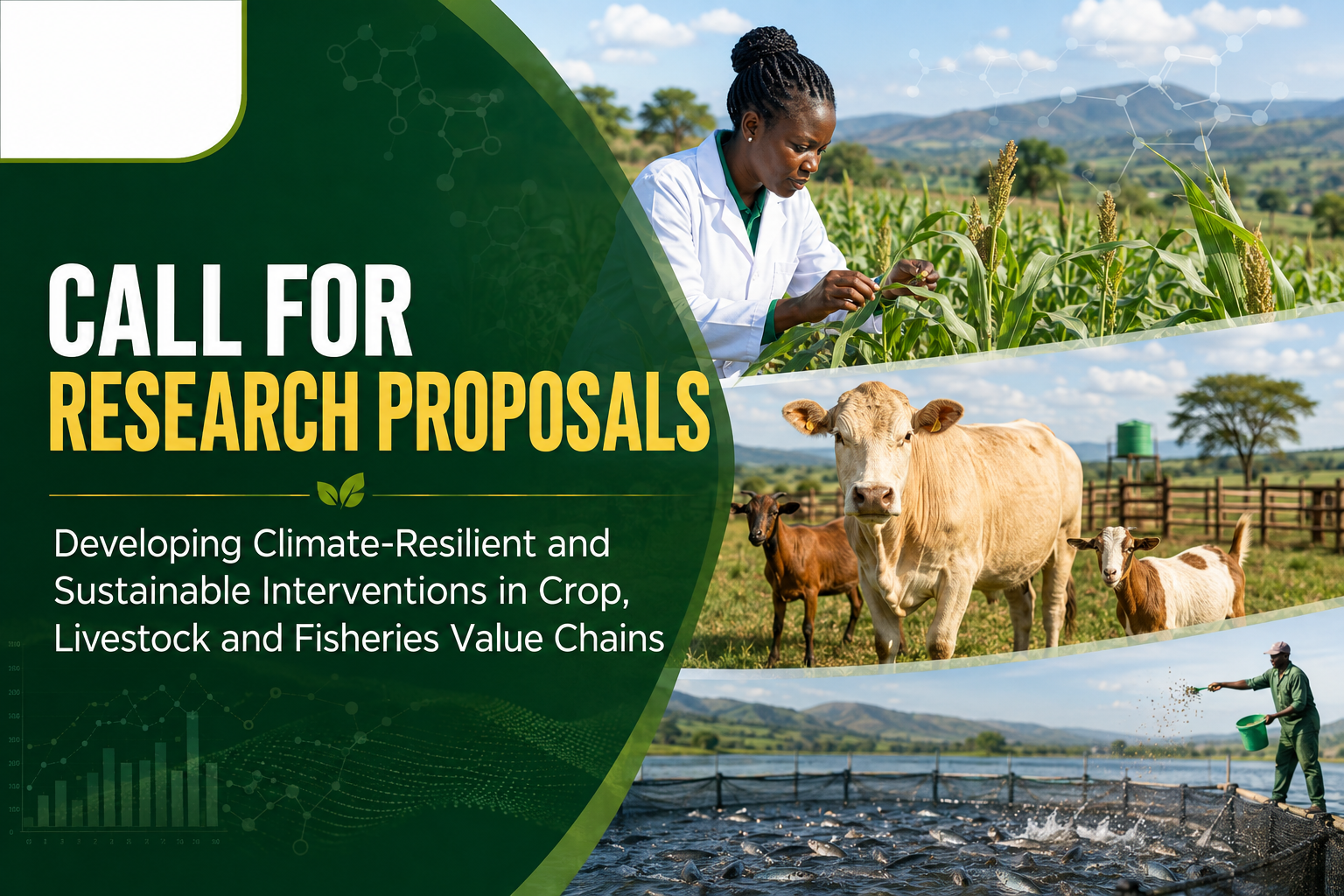
The Government of Uganda, through its Ministry of Agriculture Animal Industry and Fisheries (MAAIF) and partners, is implementing the world bank-funded Uganda Climate Smart Agricultural Transformation (UCSAT) Project (ID Number P173296). The project seeks to transform the agricultural sector by promoting climate-smart agricultural practices, enhancing productivity, and improving resilience to climate change. The project contributes to achieving the United Nations Sustainable Development Goals (SDGs), particularly SDG 1 (ending poverty), SDG 2 (ending hunger, achieving food security, and promoting sustainable agriculture), and SDG 13 (taking urgent action to combat climate change and its impacts). The project development objective (PDO) is to increase productivity, market access, and resilience of selected value chains in the project area and to respond promptly and effectively to an eligible crisis or emergency
Through her mandate of coordinating agricultural research in the country across the NARS, National Agricultural Research Organisation (NARO) is coordinating component one of the UCSAT project that seeks to Strengthen Climate Smart Agricultural Research, Seed, and Agro-Climatic Information Systems. Subcomponent 1.1 of component 1 seeks to support climate smart agricultural research innovations through awarding Competitive Research Grants (CRG) to constitute Cohort 7 of the competitive grant scheme. The scheme shall finance adaptive and applied research interventions aimed at contributing to the PDO. The call targets all stakeholders in Uganda’s National Agricultural Research System (NARS) including Public Agricultural Research Institutes (PARIs), Academia, Private sector, Civil Society Organizations (CSOs) and individuals with proven capacities to use science, to generate solutions to problems and/or exploit opportunities in the national economy.
2.0 Objective of the call
The Competitive Research Grant scheme seeks to support research interventions aimed at boosting farm production and productivity; marketability of agricultural products; and resilience of Uganda’s food systems to climatic changes; hence contributing to attainment of the project development goal. This call is in addition to two previous ones that resulted in the award and implementation of 24 Competitive Research Grants, as well as Thirty-nine (39) others that already secured a no objection for award. Under the UCSAT project, a total of 70 CRGs are targeted. This particular call therefore seeks to identify seven extra projects to fulfil the target.
3.0 Scope of this specific call
This specific call seeks to support additional seven (7) projects targeting one (1) project on coffee commodity under the crop value chain, two (2) projects under capture fisheries value chain, two (2) projects on beneficial insects value chain and two (2) projects addressing the agri-climate advisory models under the cross-cutting value chain. Each project shall be implemented for a duration not exceeding two (2) years. The total cost for each project shall not exceed USD 100,000.
4.0 Funding Windows
Financing of the Competitive Research Grants will be provided through two windows (Window 1 & 2). Window 1 will support adaptation, promotion and commercialization of climate-resilient technologies, products and services. Window 2 will support applied research aimed at development of game-changing and disruptive technologies and products for enhanced resilience of selected value chains to climatic changes.
5.0 Thematic Focus
This particular call focuses on three thematic areas covering the crop and fisheries value chains as well as cross cutting areas in these value chains, specifically targeting beneficial insects and agri-climatic advisory models. The full description of the themes is described below.
5.1 Thematic Area 1: Building climate-resilient crop value-chains
Under this thematic area, one grant will be awarded under Window 1 for interventions focusing on coffee commodity under the crop value chain.
Window 1 seeks for interventions including but not limited to (i) designing and piloting sustainable AEZ[1]-specific local seed business models including vegetative planting materials; (ii) designing and piloting AEZ-specific climate-resilient integrated production models; (iii) conducting multi-locational and adaptive trials for priority commodities; (iv) promotion of climate-resilient technologies through innovative and strategic approaches such as establishing parish-level demonstrations, supporting climate-resilient model farms/villages, tailored training and skilling approaches among others; (v) incubation and commercialization of climate-resilient technologies, products and services.
5.2 Thematic area 2: Building climate-resilient fisheries value-chains
Under this thematic area, two grants will be awarded under Window 2 for interventions focusing on capture-fisheries value chain. Window 2 seeks interventions including but not limited to (i) developing heat tolerant and high performing fish strains; (ii) developing cost-effective feed concentrates, supplements and additives; (iii) developing cost-effective water pollution management innovations including management of aquatic weeds; (iv) developing efficacious and safe fish health management products including drugs, probiotics, vaccines, and diagnostic kits among others; (v) exploitation, characterization and conservation of fisheries resources including fish, algae, planktons, and other micro-organisms of economic importance in fisheries; (vi) value addition innovations on fish products and wastes.
5.3 Thematic area 3: Cross-cutting and integrated systems for crop, livestock and fisheries value chains
Under this theme, 4 grants will be awarded for the following intervention areas as follows:
- Development and promotion of innovations for sustainable production and commercialization of beneficial insects for food and feed (2 grants).
- Designing and piloting commodity-based Agri-climate advisory models relating climatic data to commodity performance data (2 grants).
6.0 Eligibility criteria
- The call is eligible to all NARS actors in Uganda i.e. Research institutions, academia, private sector, non-governmental and civil society organizations.
- The lead applicant (PI) must be a researcher, who will bear the main responsibility for the project, including its technical and administrative coordination as well as scientific and financial reporting.
- The lead PI must be in possession of at least a master’s degree with a minimum of five (5) years of active full-time research experience at the time of application. Possession of a PhD is an added advantage.
- The lead PI must have capacity and a proven track record for managing similar projects. A certificate of project completion signed by the funder constitutes proof thereof.
- Information on the proposal format, desired page numbers, supporting documents, proposal review and scoring criteria; and eligible cost areas among others is provided in the CRG manual found at www.naro.go.ug. Note however that for this specific call, proposals must not exceed five pages.
- Proposals that focus on testing new technologies with beneficiaries rather than developing new technologies are encouraged
To ensure transparency and integrity in proposal assessment and scoring, the proposals will be evaluated according to the nine criteria stipulated in the manual and here under presented, with a total score of 100 points:
i) Innovation (15 points): Innovation is a major differentiating element for investment. Appropriateness, innovation and relevance for the target group will be taken into consideration. All proposals selected for funding should go beyond standard innovation development projects, including approaches to novel technologies; new products or services using existing technology; or new processes, including new mechanisms to deliver products or services, among others. Proposals will be assessed for originality and novelty.
ii) Clarity of Project Design (15 points): Overall project design, including specification of the problem showing the value added by the project and the feasibility and quality of the write-up, the objectives and methodology must be clear, easy to follow and replicable.
iii) Theory of change and performance management (10 points): The Theory of Change (ToC) should demonstrate how the projects will contribute to increased productivity, market access and resilience of select value chains in the project area and to respond promptly and effectively to an eligible crisis or emergency. Presence of realistic Monitoring and Evaluation framework. 18
iv) Competencies of the research team (10 points): The proposed team should reflect an appropriate mix of the competencies and experience required to achieve the project objectives and anticipated impacts. Proposals with multi disciplinarity, and multi-institutional teams that can achieve project objectives will attract comparative advantage. The role of each team member must be clearly elaborated. Evaluation will focus on how the project team conforms to the trans-disciplinary approach to deliver results. Integration of potential partners/collaborators to leverage their resident resources will be assessed. Clear definition of research activities of respective team members, and quality of conceptual framework.
v) Sustainability of Impact (10 points): Projects should indicate how the results and development impacts will be sustained after the end of the project research and development fund. This should include an articulate Exit Strategy. Assessors will evaluate potential for scaling up, replicating results and for continuity.
vi) Relevance of the project to the project development objective and national development agenda (10 points): The applicants should justify the need for the proposed intervention by showing relevance to the overall Uganda Climate Smart Agriculture project development objective as well as relevance to the Uganda NDP IV objectives.
vii) Cost-effectiveness (10 points): The applicants should show how the proposed projects will demonstrate financial viability and value for money investment in research and innovations.
viii) Risk management, environment and social safeguards (10 points): The applicants should show how the proposed intervention has carefully and logically integrated environment and social safeguards including gender and equity in the project design. In addition, all applicants should contain a realistic and logically designed risk management plan.
ix) Feasibility of the proposed interventions (10 points): The possibility of achieving the set targets and the practicability of implementing the suggested design within the available resources and timeframe will be scored. Upon receipt of the proposal evaluation results, a report summarizing all results and recommendations of the technical blind evaluation exercise will be compiled and presented to the technical assessment and evaluation committee for consideration. The final award follows a no objection from the World bank team.
7.0 Gender considerations: Female-led applications and applications involving female researchers as part of the research consortia are strongly encouraged.
8.0 Submission of applications
- An institution can submit more than one application
- A PI cannot lead more than one application but can be a co-applicant on more than one application.
- Applications should be submitted in English.
- The Deadline for submission of the proposals is 14th September 2026 at 5.00 PM.
- Applicants should submit both PDF and an editable Microsoft version of the proposal and supporting documents to: Director General, NARO atdg@naro.go.ug, with a copy to researchcoordination@naro.go.ug and grants@naro.go.ug not later than 14th September 2026
9.0 Review and selection process
The submitted proposals will undergo an administrative and eligibility check for completeness and adherence to the call guidelines as stipulated in the CRG Implementation manual available on the NARO website. Note however, that the expected number of pages per proposal for this call is 5 pages down from 12 pages. Non adherence to the page number limit will lead to automatic disqualification. The proposals that pass the administrative and eligibility check will undergo technical evaluation in accordance with the CRG manual.
10.0 Contact for further information
Any clarifications regarding this call should be sent to: grants@naro.go.ug and, researchcoordination@naro.go.ug