

Jamiru Ntale is a coffee farmer and chairperson of the Central Region Integrated Coffee and Cocoa Nursery Association (CRICCONA), an umbrella body for registered nursery operators in Central Uganda. He owns a nursery and coffee gardens in Buikwe District. But like the majority of coffee farmers in Uganda, Ntale has encountered a serious challenge that threatens his investment, the black coffee twig borer.
“I have observed that the twigs of some of the plants in my coffee garden have tiny holes; they have turned brown and are drying up, destroying the berries that were on the plant,” Ntale explains.
His experience reflects a nationwide struggle being addressed by scientists at the National Coffee Research Institute (NaCORI), where researchers have developed an innovative solution known as the black coffee twig borer (BCTB) trap.
The black twig borer has become one of the most persistent and costly pests in coffee production. It affects both Robusta and Arabica coffee, though Robusta is more heavily attacked.
Dr. Godfrey Kagezi, a Principal Research Officer at NaCORI and one of the lead scientists behind the BCTB trap, explains that the pest tunnels into coffee branches where cherries develop, disrupting nutrient flow and causing the affected branches to dry up, ultimately leading to significant loss of harvestable coffee.
The impact is not negligible. Field studies indicate that at national level, the pest contributes to nearly 9.4% loss of coffee production. In some poorly managed farms, the damage can rise to more than 50%, meaning farmers lose half of their expected yield.
For a country where coffee is a major export earner and supports millions of households, this represents a serious economic threat.

Why the black coffee twig borer is hard to control:
One of the key challenges with the black twig borer is its behaviour. Dr. Kagezi, explains that the pest is extremely difficult to manage using conventional methods.
“This is currently one of the biggest problems in coffee production, the pest spends most of its life inside the coffee stem, and by the time farmers notice it, the damage has already occurred”, he explains.
Because it hides inside the plant, chemical spraying becomes ineffective. Farmers often act too late, when branches are already drying and production has been lost.
Dr. Kagezi notes that this hidden nature of the pest is what pushed researchers to rethink control strategies.
“Even if you apply chemicals, you are already behind the pest, that is why we needed a preventive solution”, he says.
The science
The breakthrough came through understanding the behaviour of the insect. Scientists discovered that the black twig borer is highly attracted to ethanol compounds.
Dr. Kagezi explains that when coffee plants are attacked, they naturally release chemical signals, including ethanol-like compounds. The researchers used this knowledge to design a trap that imitates the same signal.
“We are not fighting the pest blindly, we are using its own behaviour against it. The principle is simple, we are mimicking nature to control the pest before it reaches the plant”, Dr. Kagezi adds.
The trap is made from local materials that are available and affordable by the majority of small-scale farmers.
How Farmers can use this trap
The BCTB technology has already been adopted and is showing results. Farmers integrate the traps into their normal coffee management practices as part of integrated pest control.
Anthony Zirabamuzale is a coffee farmer in Kyebanja B village in Busaale Parish, Kayunga district. He is one of the farmers, who have adopted the BCTB technology on his two-acre coffee garden.
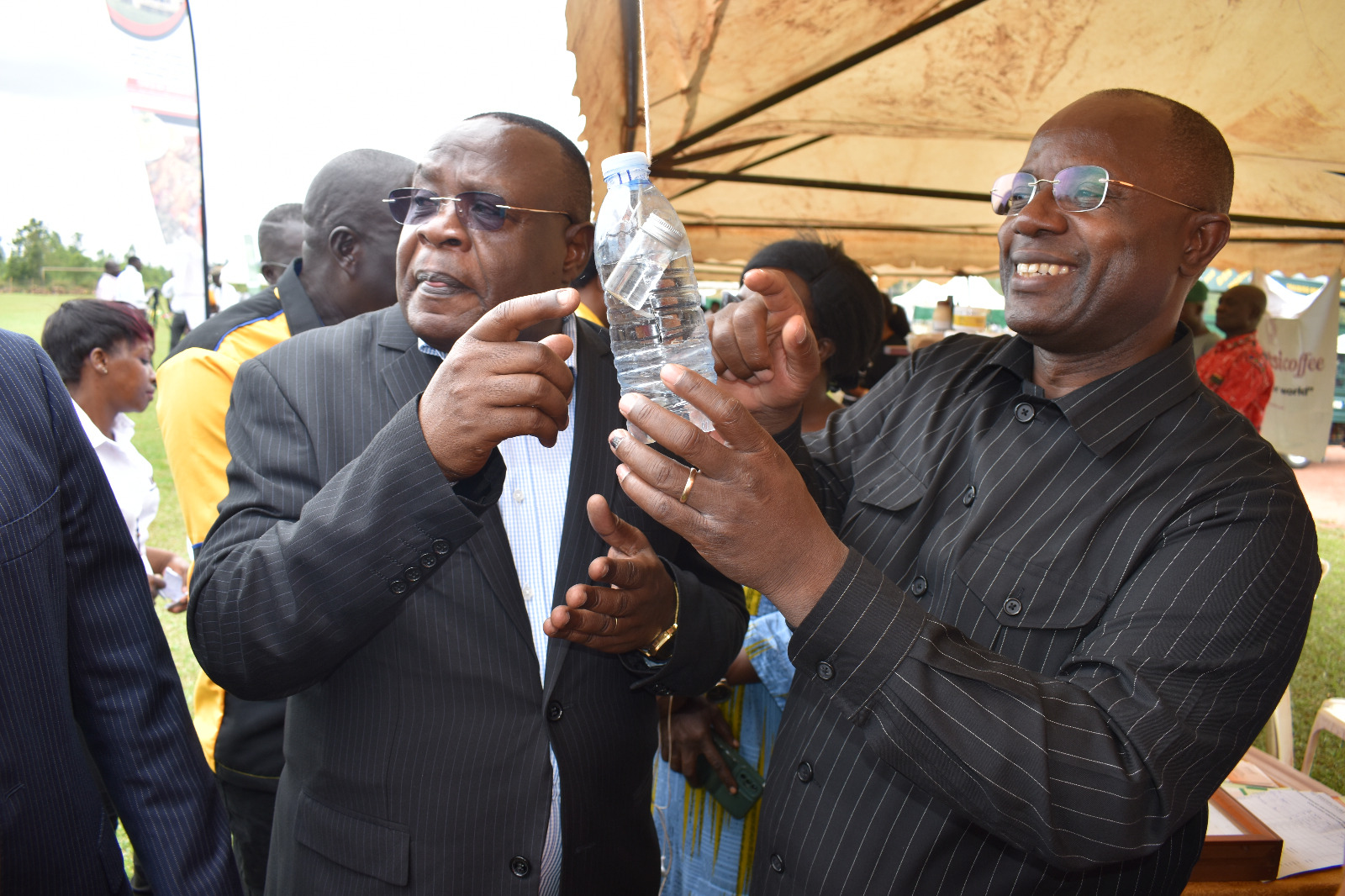
Zirabamuzale explains that he uses empty water bottles and other locally available materials. Then the trap is hung inside the coffee garden, where it attracts and captures the beetles before they enter the plant.
However, farmers must maintain the system regularly. Zirabamuzale notes that consistency is the key to success.
“You must replace some of the ingredients every two to three weeks, if you don’t maintain it, the trap stops working”, he explains.
Zirabamuzale’s experience in the field offers a practical picture of how the BCTB trap is helping farmers protect their coffee. On his farm, he explains that proper installation is key to success.
“In one acre, a farmer can install about seven BCTB traps, and that is often enough because the insect can detect the trap scent from a distance of eight to ten metres away,” he says.
For farmers with larger investments, he adds, the number can be increased to about fifteen traps per acre for more intensive control.
Zirabamuzale notes that after installation, it may take four to five days before the beetles start appearing in the traps, but with time, the numbers increase. The traps are effective not only against the black coffee twig borer, but can also catch the coffee berry borer, making them a valuable tool for farmers.
According to Dr. Kagezi, the pest is dangerous because it enters coffee branches and lays eggs. “When the eggs hatch, within about two weeks the larvae begin feeding on the plant, cutting off nutrients and damaging the coffee”, he explains, emphasizing the importance of early trapping to break the pest cycle.
Simple, and affordable
One of the strongest advantages of the BCTB trap is its affordability. Farmers can construct it using recycled materials such as plastic bottles, making it accessible even to smallholder farmers.
“This is a low-cost technology, the only important input is the attractant, which is also locally available,” Dr. Kagezi explains.
Farmers are also advised to use neutral or transparent containers, as the insect is sensitive to colour. Some colours, especially red, can repel the pest instead of attracting it.
Despite its simplicity, the trap has proven highly effective when properly used.
Environmental benefits of the trap
Unlike chemical pesticides, the BCTB trap is environmentally friendly. It targets only the pest without harming beneficial insects such as bees, which are important for coffee pollination.
“One of the biggest advantages is that it is safe for the environment, it does not disturb useful insects in the ecosystem”, Dr. Kagezi says
This makes it a sustainable solution that aligns with environmentally conscious farming practices.
The importance of community-based control
Experts emphasize that controlling the black twig borer requires collective action. Because the pest moves easily between farms, individual efforts are not enough.
“If one farmer uses the trap and the neighbor does not, the pest will continue spreading,” Dr. Kagezi explains.
He recommends community-based adoption where entire villages or parishes implement the same pest control strategy simultaneously.
This approach increases effectiveness and reduces re-infestation from neighboring farms.
Scaling up and future opportunities
Researchers are now working with private companies to commercialize improved versions of the trap. The aim is to make it more durable, standardized, and widely available.
Market studies show that farmers are willing to adopt the technology, if it is affordable and accessible. There is also potential for youth involvement in manufacturing, distribution, and installation of traps, creating employment opportunities in rural areas.
Extension services continue to play a key role in training farmers and ensuring proper adoption.