
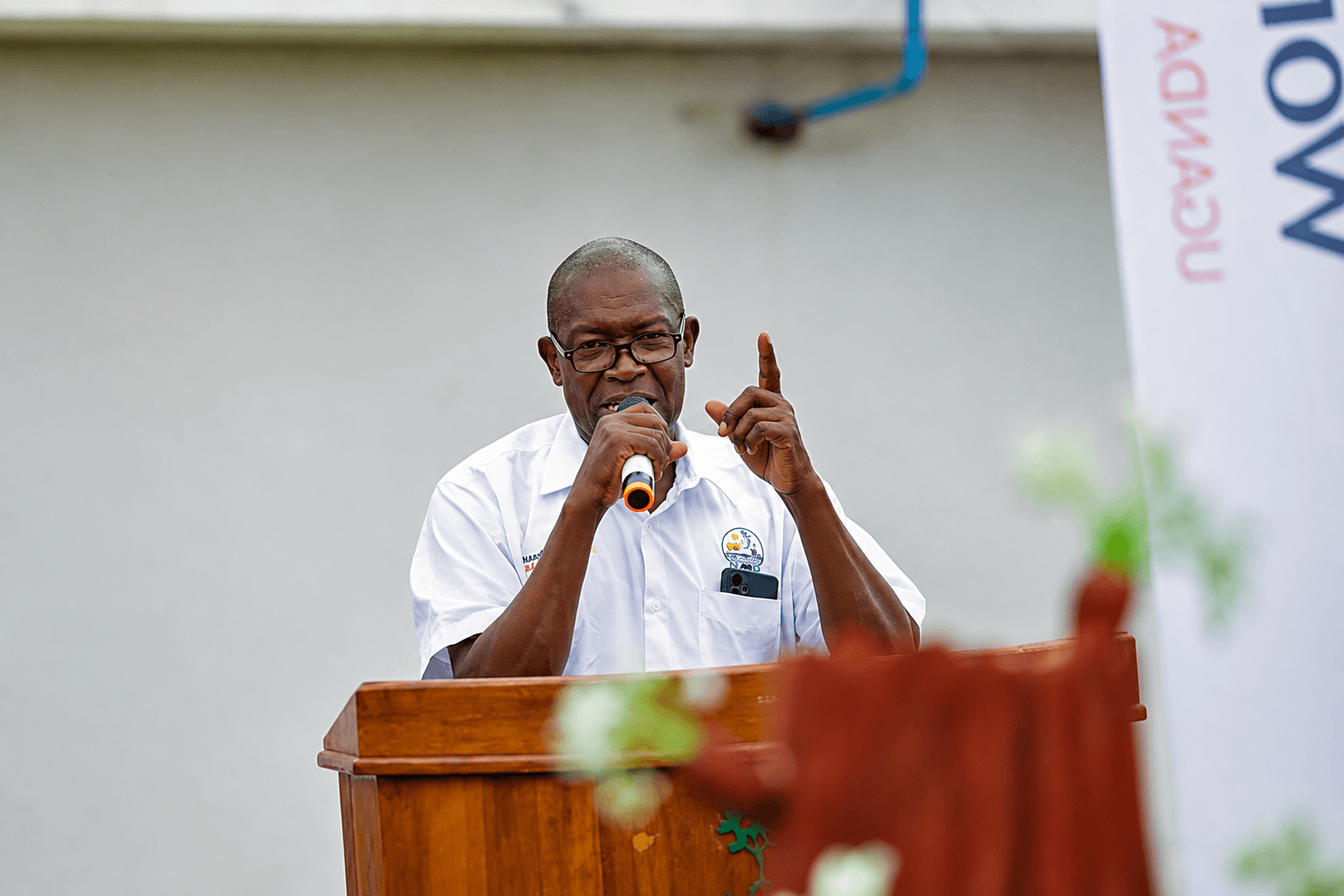

Speaking at NaFORRI’s commemoration of the International Day of Forests in Mukono District, the Chairperson of the NARO Governing Council, Dr. William Olaho Mukani, raised concern over the accelerating loss of forest cover in Uganda, describing it as a challenge that extends beyond NaFORRI to NARO, the Ministry of Agriculture, Animal Industry and Fisheries (MAAIF), the Ministry of Water and Environment, and the country as a whole.
NARO Chairman Governing council, Dr. William Olaho Mukani while delivering his keynote speech.
Dr. Olaho Mukani noted that encroachment and land grabbing continue to drive deforestation, and pointed to neighbouring countries such as Kenya and Tanzania, where dedicated forest ranger systems and strict enforcement have helped curb illegal activity in protected forest areas. He observed that while Uganda already has strong environmental laws and policies in place, enforcement remains weak, and called on government to prioritize both the protection of existing forest cover and the restoration of degraded areas.
Recalling remarks made by President Museveni during a visit to Tororo in the late 1990s, Dr. Olaho Mukani illustrated the scale of tree loss across parts of the country, noting that visibility across once-forested landscapes had become a stark indicator of denudation. He called for deliberate government action to promote tree planting, and proposed the reinstatement of the “farm planning” concept previously part of Uganda’s agricultural extension framework which encouraged households to set aside small woodlots for building materials, firewood, and other domestic needs. He urged government to consider this as part of any future policy review of the agriculture sector.
Linking the discussion to this year’s International Day of Forests theme, “Forests and Economies,” Dr. Olaho Mukani encouraged scientists and the public to look beyond farming and research in isolation, and to consider the direct economic potential of forest resources from the “pathogen economy” model seen in disease diagnostics to the many medicinal compounds derived from trees. He challenged NaFORRI’s Director of Research and research team to strengthen public understanding of the full value chain of trees, citing the jackfruit as an example: beyond its fruit, the tree’s roots, leaves, and trunk carry medicinal and other economic value that is not widely known.
He further urged NaFORRI to expand production of quality-assured tree seedlings, working alongside MAAIF and the Ministry of Water and Environment to support rather than displace informal roadside seedling vendors by improving the quality of planting stock available to farmers and the public. He also encouraged the Institute to partner with schools in Mukono and beyond to plant trees on school compounds, engaging children directly in restoration efforts.
Dr. Olaho Mukani cited NARO’s development of a tick vaccine as an example of how government investment follows demonstrated research impact, expressing confidence that the vaccine’s rollout would benefit both livestock health and, indirectly, forestry through improved manure availability for soil health. He closed by urging NaFORRI to generate the evidence and statistics needed to influence policy and funding decisions, noting that forests much like the Congo Basin and the Amazon hold significant untapped economic potential for Uganda.