
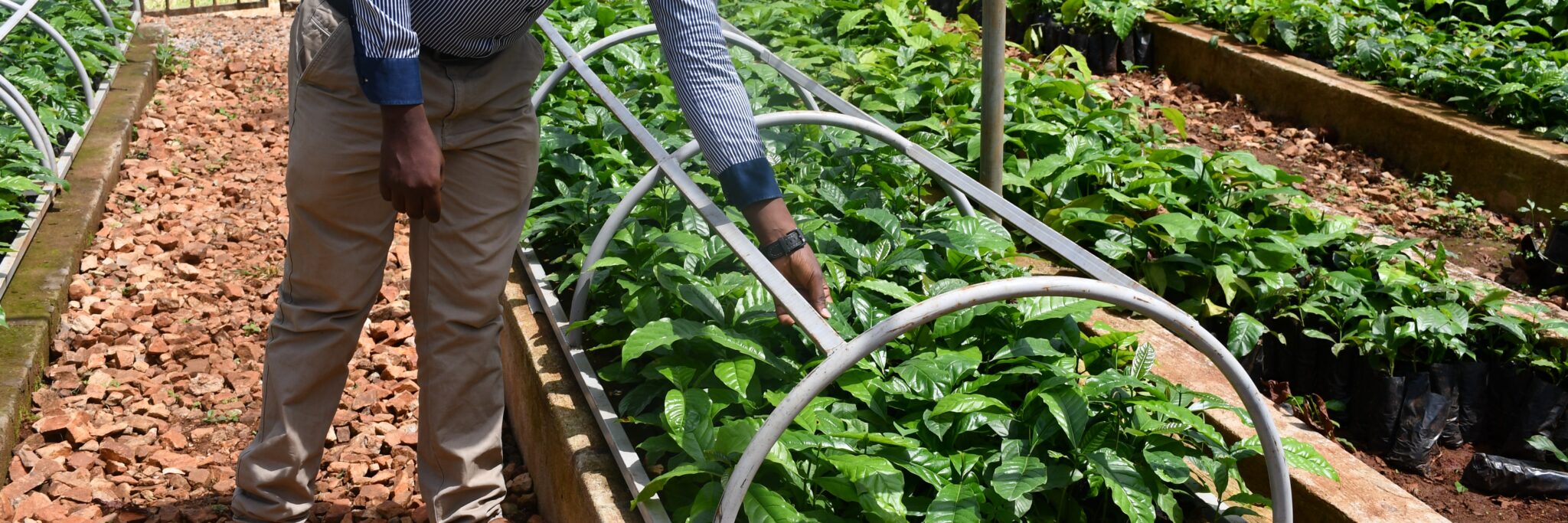

For years, many coffee farmers across Uganda struggled with poor yields, pests, and diseases, mainly because they lacked access to proper knowledge about modern and resilient coffee varieties. Farmers such as Yekosefati Sekabembe of Kiyunga, Naluwonga Parish in Mubende District had passion and land, but faced serious challenges, from planting the wrong varieties to battling coffee wilt disease.
Everything changed when the National Coffee Research Institute (NaCORI) began training farmers in good agricultural practices, disease management, and the use of improved coffee varieties. Through NaCORI’s guidance, Sekabembe learned the importance of selecting quality seedlings, proper spacing, organic pest control, and soil fertility management.
Today, his 25-acre coffee plantation stands as a model of productivity and sustainability. The once-struggling gardens are now lush and disease-free, yielding high-quality beans that attract buyers from near and far.
Sekabembe’s story reflects the broader transformation NaCORI has inspired among farmers nationwide, turning smallholders into commercial producers through practical training and innovation. Farmers now understand that success in coffee farming begins with knowledge, not luck. With NaCORI’s continuous support, many who once despaired now see coffee not just as a crop, but as a reliable source of income and national pride.
Awakening a coffee nation
Dr. Geoffrey Arinaitwe, the Director of research at National Coffee Research Institute (NaCORI), explains that the organisation’s renewed focus is on empowering ordinary farmers, the backbone of Uganda’s coffee industry.
“We realised that research and innovation mean nothing if they stay in laboratories. NaCORI’s mission is to take science to the people and make every farmer understand that knowledge is the true fertiliser for success,” he says.
This vision led to the birth of the Coffee Genius Experience, a platform designed to connect farmers, researchers, and coffee lovers through learning and culture.
It all began with the Kituza Coffee Night, a meet-and-greet evening gathering at NaCORI filled with roasted meat, music, and laughter.
“That evening changed everything. We saw coffee bringing together science, culture, and community,” Dr. Arinaitwe recalls.
From that success came Urban Coffee Vibes, a city-based event featuring coffee cocktails, performances, and interactive learning.
“It was not just entertainment; it was education disguised as fun, our way of awakening a coffee nation from the grassroots to the cities,” Dr. Arinaitwe adds.
From spark to fire
Encouraged by the success of those events, NaCORI launched Coffee Spark, a campaign to ignite curiosity and promote the use of locally developed coffee technologies.
“Just like electricity, a spark creates light. We wanted to spark a movement that would spread coffee awareness across Uganda,” says Dr. Arinaitwe.
The following year, they introduced the Coffee Fyre Experience, a larger and more electrifying celebration combining fashion, art, and science.
“We partnered with the Work Foundation in Northern Uganda, we had models wearing coffee-inspired outfits, musicians performing coffee songs, and demonstrations of our innovations,” he explains.
Uganda’s identity, culture, and economic future. Farmers started asking questions about seed varieties, drying techniques, and market opportunities. The institute’s outreach model had worked; research was finally in the hands of the people.
The presidential vision
Dr. Arinaitwe highlights that Uganda’s coffee renaissance aligns with President Yoweri Museveni’s 2017 directive to increase production to 20 million bags for export.
“The president’s vision is genius. You can’t talk about exporting processed coffee without increasing production. His directive covered everything, production, processing, research, seed multiplication, and market access,” he says.
Under this vision, NaCORI’s role has become even more crucial. The institute focuses on developing pure, high-yielding coffee varieties suited to different climatic zones.
“Uganda can only hit that 20-million-bag target if farmers get access to quality seed and research support. That’s why we are setting up sub-centres across the country, bringing NaCORI closer to farmers,” says Arinaitwe.
Reviving northern Uganda through coffee
Beyond production targets, coffee is becoming a tool for social transformation, especially in Northern Uganda, where decades of conflict left deep scars.
Dr. Arinaitwe praises the leadership of General Salim Saleh and other visionaries who see coffee as a path to peace and productivity.
“In Northern Uganda, poverty, drug abuse, and domestic violence are all linked. When men have no income, they lose dignity, turn to alcohol, and families suffer. But coffee changes that, it gives land value, creates work, and restores self-respect,” he says.
NaCORI has partnered with cultural and local organisations such as Rochopacho, led by Chief Justice Owiny-Dollo, to help change mindsets.
“In Acholi, the Chief Justice works with respected community elders, the ‘elephants’, to promote coffee farming. We realised the Acholi love music, drama, and dance, so we decided to communicate coffee through art and culture,” says Arinaitwe.
Using a blend of creative arts, cultural leadership, and agricultural science, NaCORI is turning formerly idle youth into productive farmers.
“If every family in Acholi planted coffee under shade trees, you would fight hunger, poverty, and domestic violence in one stroke,” he notes.
Research meets creativity
For a region where high temperatures and prolonged dry seasons threaten crops, NaCORI is focusing on climate-smart coffee production.
“In Northern Uganda, coffee can dry up within two months. We are developing varieties that can withstand drought and introducing intercropping systems, planting coffee under trees and bananas for shade,” Arinaitwe explains.
Through this approach, NaCORI blends science with creativity. Farmers are trained not just in planting and harvesting, but also in storytelling, turning coffee into a cultural expression.
“When you combine science, culture, and music, people listen,” he says.
Ugandan coffee on the global stage
Unknown to many, Uganda is the birthplace of some of the world’s finest coffee varieties.
“Globally, we have the best Robusta coffee. All those letters you see, KR1, KR2, KR3, stand for Kituza Robusta, developed right here in Uganda,” says Dr. Arinaitwe.
NaCORI is currently testing KR11 and KR12, the next generation of coffee varieties bred for resilience and high cup quality.
“Vietnam and Brazil export more coffee, but they use weaker varieties, many of which originally came from Uganda. We have global demand for our varieties. A company in Switzerland wants to introduce them to Latin America, but we’re cautious. We don’t want to lose our genetic treasure,” he reveals.
For farmers, these varieties promise higher yields, disease resistance, and better prices. For exporters and investors, they ensure a consistent supply of premium beans that meet international standards.
Homegrown innovators
Dr. Arinaitwe is quick to celebrate other Ugandan innovators reshaping the coffee industry.
“We must appreciate people like Andrew Rugasira of Good African Coffee. He was among the first to take Ugandan coffee to the international shelf, roasted and packaged locally,” he says.
He also applauds Nelson Tugume of Inspire Africa Group, who is leading efforts to process coffee within Uganda rather than exporting raw beans.
“Processing coffee locally keeps value in the country,” Arinaitwe says.
Then there is Emmanuel Iyamulemye, the former Director of the Uganda Coffee Development Authority (UCDA), whose bold move to exit the International Coffee Organisation strengthened Uganda’s position in global markets.
“He showed that Uganda could negotiate better prices independently,” says Arinaitwe.
He also recognises Frank Tumwebaze, the current Minister of Agriculture, who is ensuring that pure coffee seed is produced and distributed closer to farmers.
“His idea of regional NaCORI centres is visionary, it brings research directly to the farmer’s doorstep”, Dr. Arinaitwe adds.