
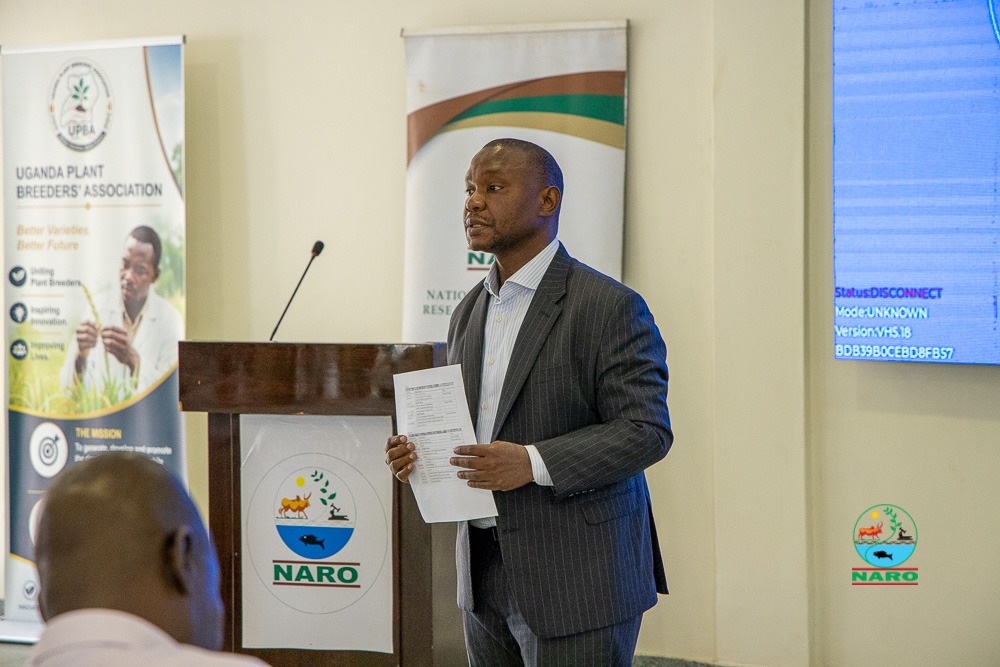

To ensure public investments in agricultural innovation translate into verifiable, ground root results, the National Agricultural Research Organisation (NARO) has convened key leadership and technical experts at the National Crops Resources Research Institute (NaCRRI) for a high-level, three-day (25th- 27th August) strategic alignment workshop.
The retreat brought together Planning, Monitoring, Evaluation, and Accountability (PMEA) specialists, financial officers, socio-economists, and PMEA focal persons to overhaul operational efficiency, eliminate institutional silos, and integrate fiscal management directly into project evaluation.
Setting an intentional tone for the proceedings, NaCRRI Director Dr. Titus Alicai warned against institutional inertia, invoking a timeless operational truth: “Failure to plan is planning to fail.” Dr. Alicai emphasized that sustainable agricultural transformation depends entirely on structured, data-driven planning. Addressing capacity bottlenecks across NARO’s network, he praised the strategic deployment of PMEA focal persons to bridge existing skill gaps.
“With high-value research underway across our institutes, we must systematically capture, filter, and report our achievements,” Dr. Alicai noted, commending NARO central executive leadership and the Government of Uganda for providing the strategic backing to consolidate institutional efforts.
Facilitating the strategy sessions, Dr. Swidiq Mugerwa, Deputy Director General in charge of Research Coordination, addressed the operational risks linked to weak planning, monitoring, and financial accountability. He reflected on the development and formal approval of the comprehensive PMEA policy, along with its supporting guidelines and strategies, by the NARO Governing Council.
Dr. Mugerwa pointed out a practical challenge: policy adoption hinges on active engagement with the documentation. He urged team leaders to download, distribute, and thoroughly review the policy framework across all staff tiers, noting that implementation cannot occur without widespread familiarity. Shifting focus to institutional oversight, Dr. Mugerwa stressed the strict independence of the internal audit team. He challenged auditors to master approved workplans and strategic blueprints, ensuring every audit exercise directly measures progress against authorized organizational targets.
Reinforcing the financial dimensions of institutional oversight, Director of Finance Julius Tegiike delivered a presentation detailing the role of finance and accounting across the entire PMEA cycle. His session outlined the progression of reporting from raw transactions to strategic executive decisions, key internal controls designed to strengthen monitoring systems, a proposed Finance–PMEA integrated dashboard, and high-priority action items for the organization.
He summarized the core alignment between fiscal management and project monitoring: sound financial and accounting practices give credibility to performance data by demonstrating exactly how committed resources are controlled and converted into measurable research outcomes.
Ultimately, the three-day retreat marks a decisive step in embedding institutional discipline across NARO ensuring that every shilling spent yields measurable, transformative outcomes for Uganda’s farming communities.