
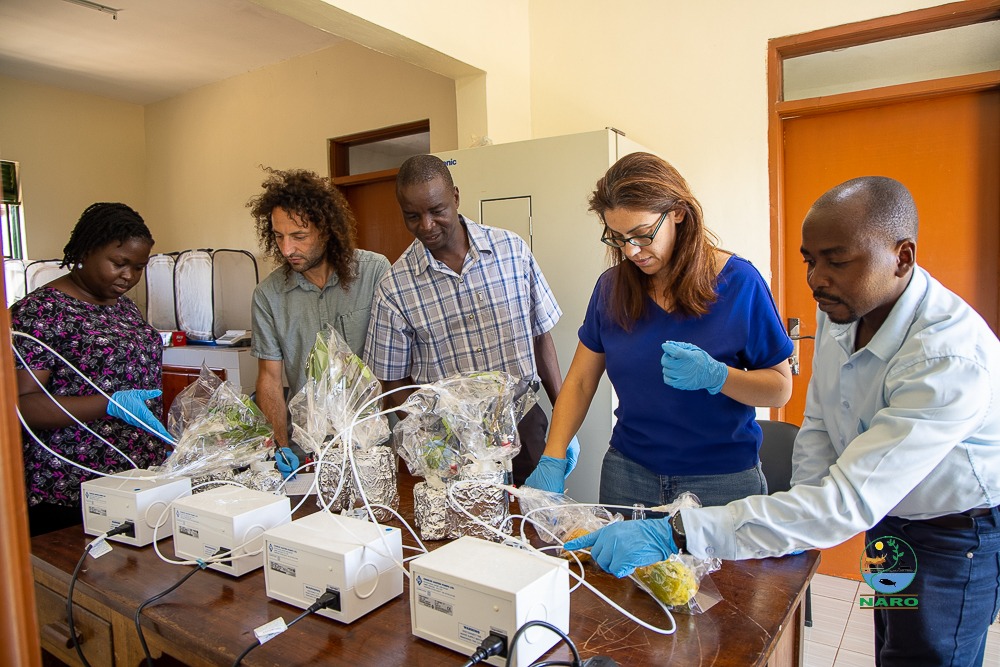

A team of international experts recently were at the National Crops Resources Research Institute (NaCRRI) in Uganda to kick off a crucial phase of the EmergeNOW project. The visiting delegation was received by the Director of Research at NaCRRI, Dr. Titus Alicai, alongside Dr. Michael Hilary Otim, Senior Principal Entomologist.
The visit focused on hands-on training for the NARO team in collecting volatile organic compounds (VOCs) emitted by infested and healthy citrus fruits and seedlings. As part of this initial data collection initiative, researchers were trained to operate an electronic nose (e-Nose), an advanced sensor-based device that mimics human olfactory capabilities to detect and identify complex gas profiles and plant pathogens in real time.
Reflecting on the training, Dr. Michael Hilary Otim expressed appreciation for the opportunity, noting that the knowledge and skills gained, together with the tools developed through the training, will strengthen local capacity to detect pests before agricultural produce is exported.
“This training has equipped us with valuable knowledge and skills, and the tools developed will significantly strengthen our capacity to detect pests before they reach the export stage,” Dr. Otim said.
This collaborative field exercise is part of Emergent Detection Technologies for Plant Health Diagnostics at EU Import Points (EmergeNOW), a three-year Innovation Action project (September 2025 – August 2028) funded under the EU’s Horizon Europe programme. Coordinated by the Centre for Research and Technology Hellas (CERTH) in Greece, the consortium unites 12 EU partners with key international institutions across Uganda, the United States, and Vietnam to revolutionize plant health inspections at ports and airports.
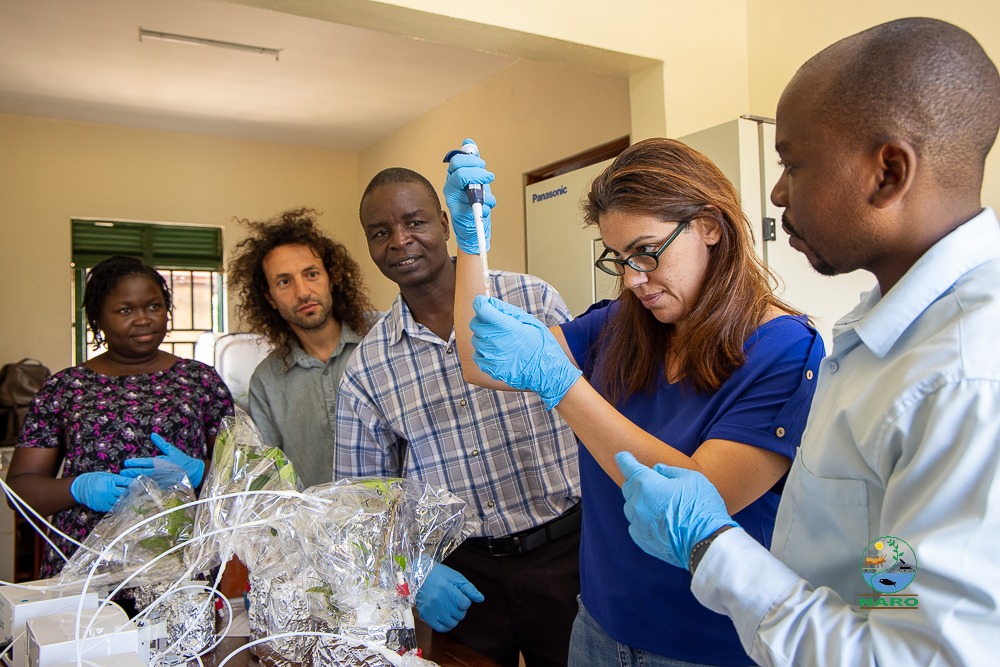
The EmergeNOW framework deploys a suite of cutting-edge digital and molecular tools designed for rapid, on-site detection of Citrus Black Spot (CBS), Citrus Greening Disease/Huanglongbing (HLB), and key insect vectors. Key innovations include:
Molecular & Sensor Diagnostics: Recombinase Polymerase Amplification (RPA) kits for rapid field diagnostics, High Throughput Sequencing (HTS) assays, Fluorescent Array-based Sensor Devices (FAST), and the IoT-driven e-Nose system being tested at NARO.
AI & Autonomous Monitoring: Autonomous Mobile Robots (AMRs), AI-powered Unmanned Aerial Vehicles (UAVs), smart robotic traps, and mobile applications for hyperspectral image analysis.
Diagnostic data from these field devices will feed directly into a secure Decision Support System (DSS) leveraging Machine Learning and blockchain technology to function as an international Early Warning System. The initiative also features a Digital Social Collaboration Platform (DSCP) for stakeholder knowledge sharing and a Digital Research Object Portal (DROP) for data management.
Following initial biosecure testing in specialized Plant Health Centers, the validated technologies—including the VOC tracking methods refined with the NaCRRI team will undergo rigorous field trials targeting specific threats in Uganda (CBS, HLB, and Trioza erytreae), the United States, Vietnam, and Cyprus.
Final operational demonstrations will take place at authorized EU Border Control Posts in Greece, Italy, Spain, and Cyprus, helping to strengthen early detection, improve plant health surveillance, and protect agricultural production and global supply chains.